

A guide for KDP publishers
Create mystery puzzle books for Amazon KDP
A mystery puzzle book asks the reader to solve crimes, not fill in grids. Each case needs a scene, suspects, clues that lead to exactly one answer, room to work it out, and a solution that proves it. This guide covers how to plan such a book for Amazon KDP, what makes each case fair, and how to prepare an interior for print — with real pages made in Cluevora.
See it with your own cases
- 3 free mystery generations
- No credit card required
- The real Cluevora Studio

What a mystery puzzle book is
A mystery puzzle book is a collection of short, self-contained crime cases. Each one sets a scene — a victim, a place, a handful of suspects — and gives the reader numbered clues. The reader’s job is to reason from those clues to the one suspect who did it. Readers often call them whodunit puzzles or “find the killer” books.
The best ones feel like a detective story you take part in, but they are logic puzzles underneath: every clue rules something in or out, and the answer is reached by deduction, not by guessing the author’s twist. That is what separates them from mystery fiction, and it is what makes them hard to produce well.
How it differs from word-search and sudoku books
Word searches, sudoku and mazes are generated grid by grid; any valid grid is a usable page. A mystery case is different in three ways that matter when you publish:
- It has to be solvable from the page. A case with two possible culprits, or a clue that contradicts another, is not a hard puzzle — it is a broken one, and readers notice.
- It is several pages, not one. The reader needs the case itself, space to work, and a solution that explains the reasoning, not just an answer key.
- It needs a story layer. Names, rooms, a victim and a premise turn a logic grid into a case someone wants to solve.
So the work is less about volume and more about checking: a book of thirty cases is thirty separate logic problems, each of which has to hold up.
Plan the book before you generate anything
A few decisions made up front keep the book consistent from the first case to the last.
Choose the kinds of case
Cluevora makes four kinds, and every kind produces the same three pages. You can keep a book to one kind or mix them:
- Classic Whodunit — one murderer, proved from the clues alone.
- The Accomplice — two statements, one false: name the murderer and the accomplice.
- The Tell-Tale — one piece of evidence is central to the solution.
- Grand Mystery — place a missing object, then name the murderer.
Set a difficulty curve
Readers enjoy a book that starts gently and builds. In Cluevora, Classic Whodunit and Tell-Tale cases come in Rookie, Investigator and Mastermind levels, so you can order a book from easy to hard. Case size is a second dial: 4 to 6 suspects per case, and 7 or 8 in the larger Classic Whodunit combinations.
Decide where the solutions go
Solutions printed straight after each case are convenient but easy to spoil; a solutions section at the back is safer for the reader. Pick one before you assemble the book (more on this below).
Pick the trim size early
The trim size changes how much fits on a page, so choose it before you build the book rather than after. Large formats such as 8.5 × 11 in give maps and clue lists room to breathe; smaller trims suit a pocket-sized book with fewer, simpler cases.
What makes a case solvable
A fair mystery case has a few properties you can check for, whatever tool you use:
- Exactly one possible culprit. Not one likely culprit — one that the clues allow, with every other suspect ruled out.
- Everything needed is printed. The reader should never need knowledge the page does not give.
- No clue gives it away alone at harder levels, so the reader has to combine them.
- The answer is not leaked by the layout — for example, by the order suspects are listed in.
Checking this by hand is slow and error-prone, because a single ambiguous clue can open a second solution. Cluevora builds each case from its answer outward, then a solver works through the printed clues to confirm the case can be solved from what is on the page and, where the mystery calls for one murderer, that the clues lead to exactly one suspect. As with any book, read your pages before you publish.
For the whole method — clue families, testing for zero, one or many solutions, redundant clues and the solution chain — worked through on a real case, see how to design a mystery puzzle with exactly one solution.
Maps, clues and Investigation pages
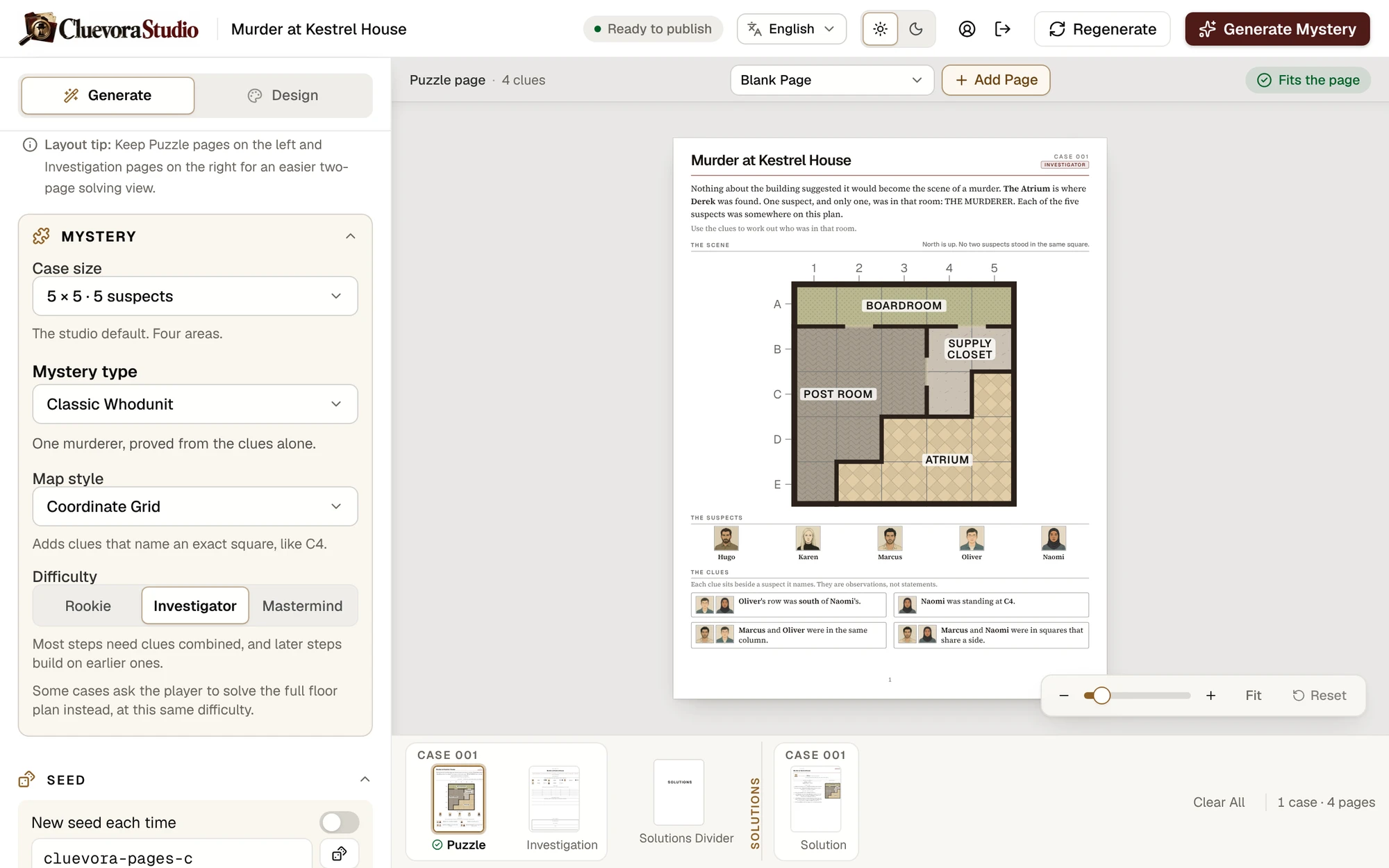
Most mystery puzzle cases are spatial: who was in which room, beside what, facing which way. A map turns that into something the reader can reason about. Cluevora’s map styles range from Rooms Only, where clues name rooms and nothing needs counting, through Spatial and Coordinate Grids, where clues use rows, columns and exact squares like C4, to furnished plans where the furniture itself appears in the clues.
Each case in Cluevora is three pages. Here is one real case, Murder at Kestrel House, as exported:
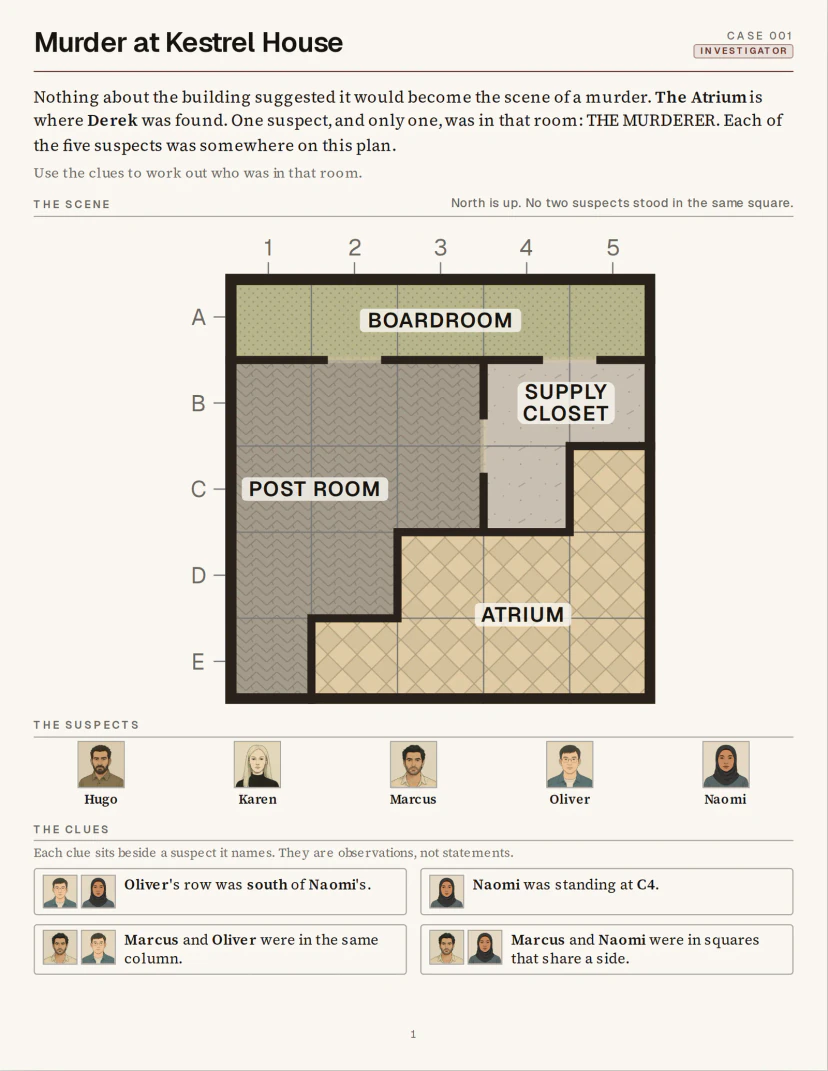
Puzzle page. The scene, the suspects and the numbered clues — nothing that gives the answer away. 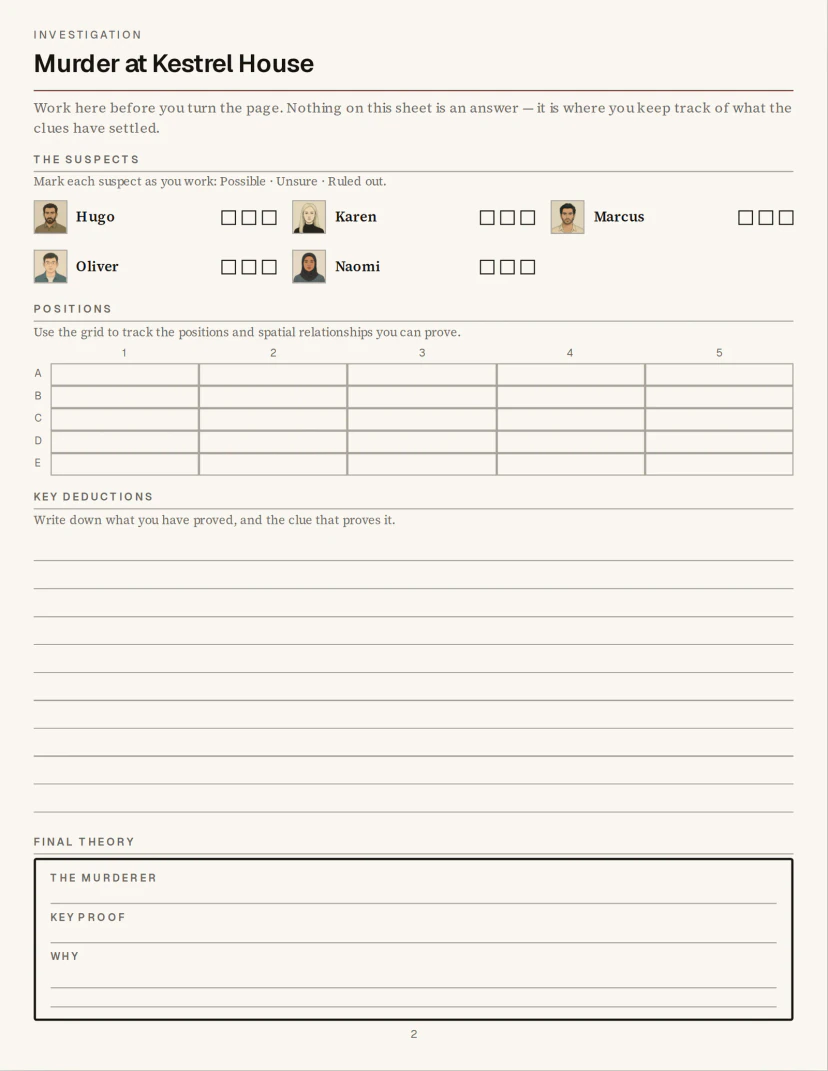
Investigation page. A worksheet: mark suspects, place them on the grid, note deductions, commit to a theory. 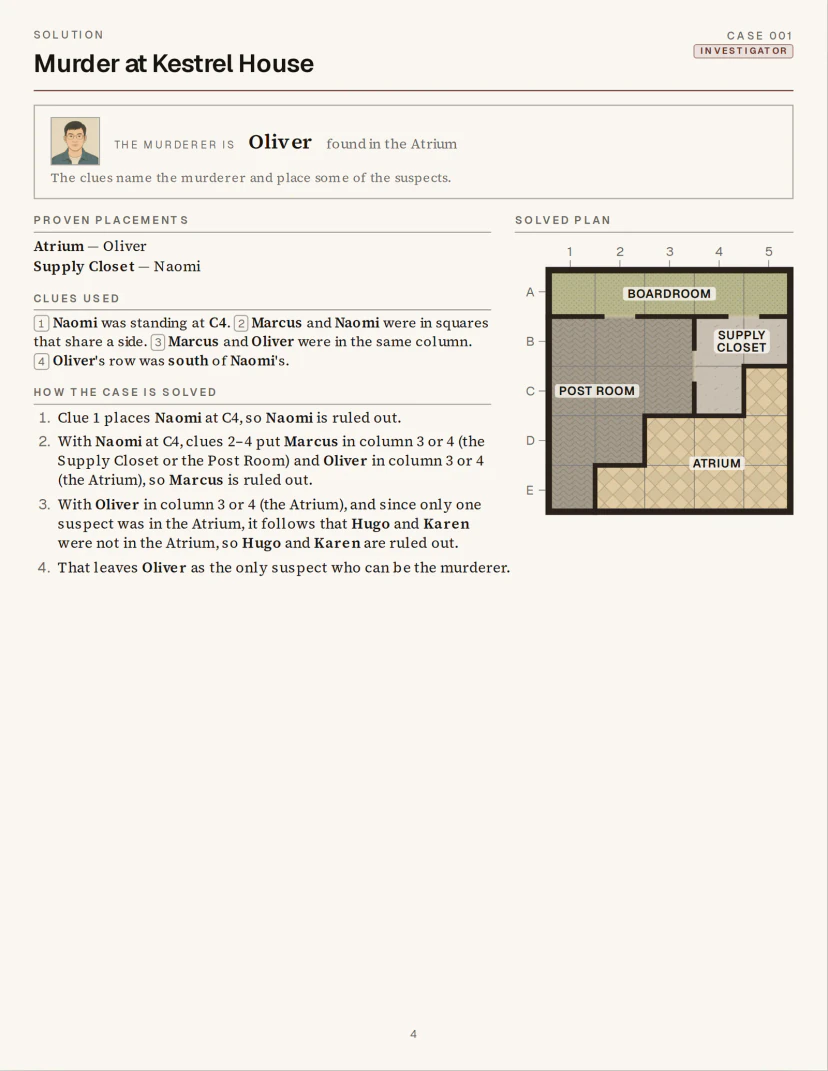
Solution page. The murderer named, the solved plan, and the reasoning step by step, citing the clues.


The Investigation page is what makes a book feel generous: readers who like to work on paper get a structured place to do it, and the Puzzle page stays clean. The other three kinds of case use the same pages with their own twists — statements to test, a central piece of evidence, a missing object to place:
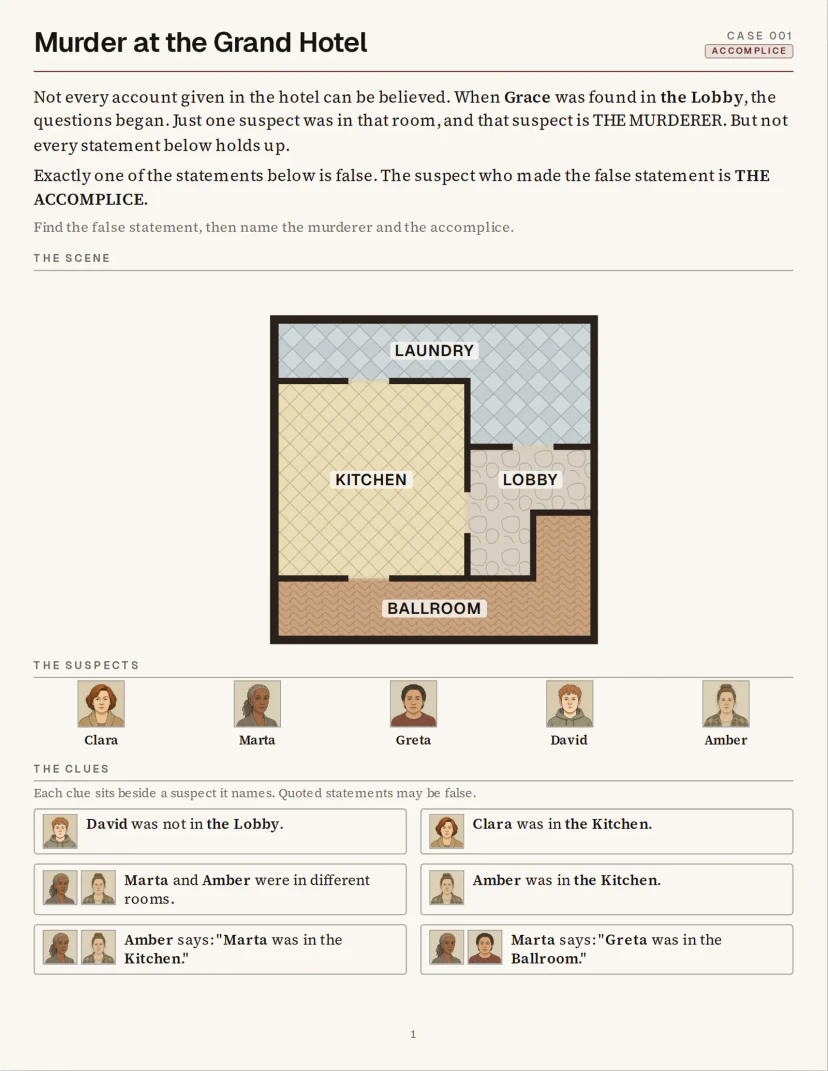
The Accomplice 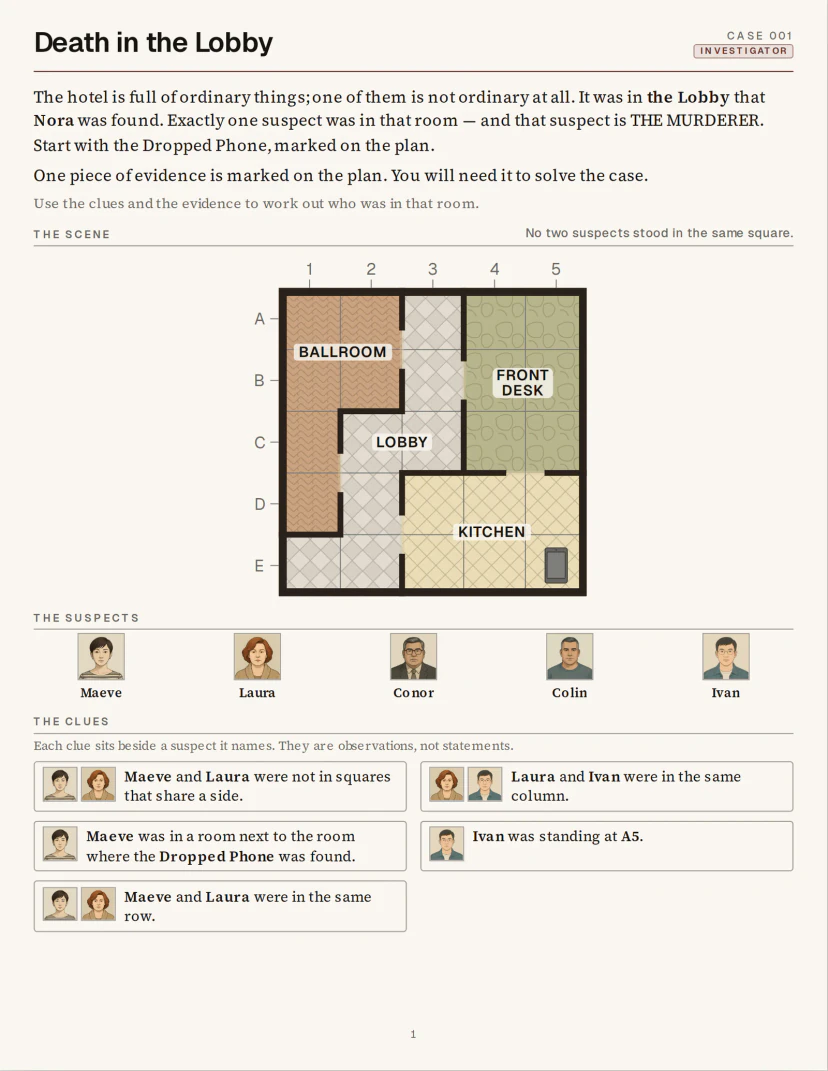
The Tell-Tale 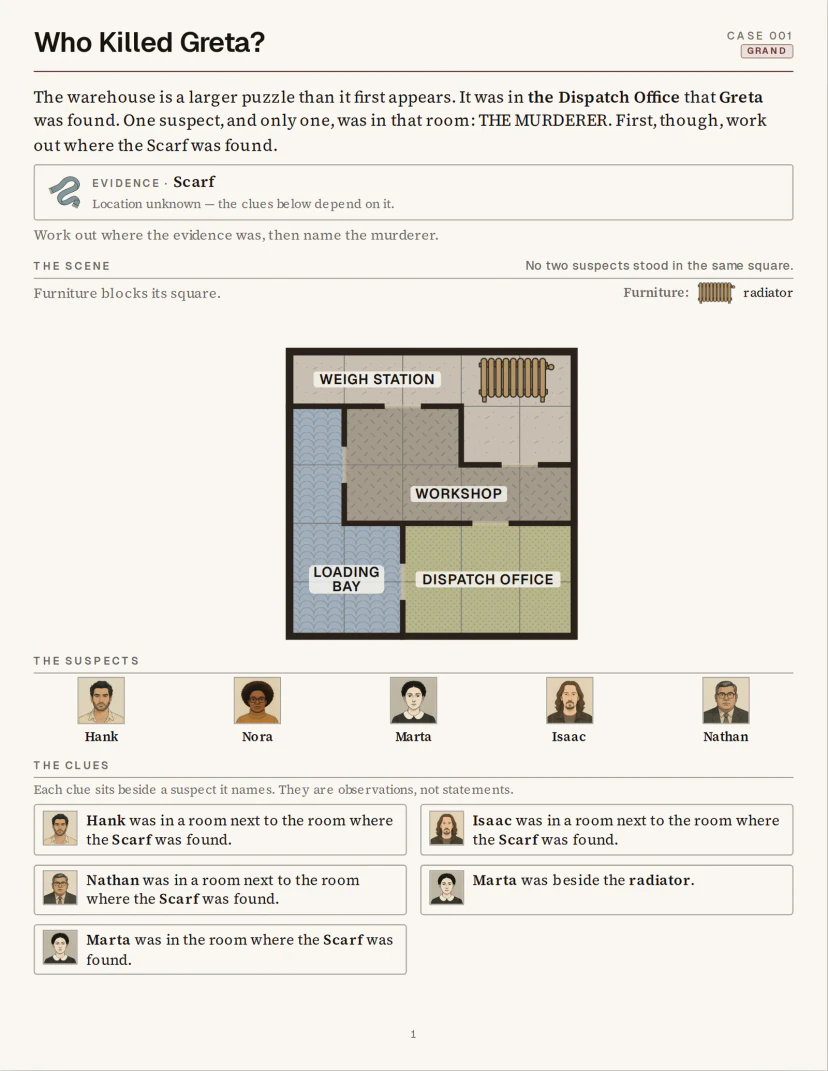
Grand Mystery


See every page of a complete case, and one from each mystery type, in real mystery puzzle book examples.
Including the solutions
A one-line answer key is not enough for a logic mystery: a reader who got it wrong wants to see where their reasoning slipped. A good solution names the culprit, shows the solved scene, and walks through the deduction in order, citing the clues by number. Cluevora’s Solution page does exactly that.
Where to put the solutions is a design choice. In Cluevora a book can place them:
- at the end of the book — with a Solutions divider page in front of them if you like — so nobody spoils the next case by turning the page; or
- straight after each case, which suits books meant to be solved one sitting at a time.
Case numbers run from Case 001 to the end of the book, so a solution is always easy to find.
Preparing a print-ready interior
For a paperback, KDP prints your interior PDF at the trim size you choose. Before you upload, check the current requirements in KDP Help and review the result in KDP’s own previewer — KDP decides what it accepts. Here is how Cluevora prepares the interior; for the formatting rules themselves — trim, bleed, margins by page count, the PDF and the cover file — see how to format a puzzle book for Amazon KDP.
Trim sizes
Cluevora lays a book out at any of these sizes: US Letter — 8.5 × 11 in, A4 — 210 × 297 mm, 6 × 9 in, 6.14 × 9.21 in, 6.69 × 9.61 in, 7 × 10 in, 7.44 × 9.69 in, 7.5 × 9.25 in, 8 × 10 in.
Margins, gutter and bleed
Cluevora exports interiors with no bleed: everything is printed within the trim, with at least 0.25 in on the outside, top and bottom. The inside margin (the gutter) grows with the page count, because thicker books need more room at the spine:
| Pages | Inside margin |
|---|---|
| 24–150 | 0.375 in |
| 151–300 | 0.5 in |
| 301–500 | 0.625 in |
| 501–700 | 0.75 in |
| 701–828 | 0.875 in |
The Studio will not export a book past 828 pages — Cluevora’s limit, the highest page count KDP lists for a paperback; KDP’s own maximum depends on ink, paper and trim. It asks you to split a longer book into separate books first.
The export
The print file is a 300 DPI PDF of the whole book. Its pages are images, so the text is not selectable or searchable — fine for print, but worth knowing if you also plan an ebook. Paid plans can also export a ZIP of PNG pages. Before exporting, the Studio flags any page whose content does not fit, so you can fix it first.
The rest of the book
A finished book usually needs front matter — a copyright page, “How to Solve” instructions, perhaps a “This Book Belongs To” page — which Cluevora can add as pages of the book. The cover is a separate file from the interior: it needs to be made for your trim size and page count — your own design, a designer’s, or one made with KDP’s Cover Creator.
Practical publishing considerations
- Rights. Paid Cluevora plans include commercial-use rights for the books you create; the commercial-use summary explains what you may sell. Content made on the free Trial is for evaluation only.
- Make the book yours. Generated cases are not exclusive to you. Your title, theme, the order and difficulty curve you choose, and your own front matter are what make a book distinct.
- Review every page. Read each case and its solution before you publish, as you would any book.
- Marketplace decisions are the marketplace’s. Cluevora is not affiliated with, sponsored by or endorsed by Amazon, and cannot guarantee that KDP accepts a book or that it sells; see the earnings disclaimer.
- Keep backups. Your book is saved in your browser, not on our servers; save a project backup file as you go.
Try it in the real Studio
The free Trial runs the same Studio and the same case engine as the paid plans. You can generate 3 mysteries with 4 to 6 suspects, in English and the Classic Print style, and export 1 watermarked PDF to see the pages for yourself. Sign in with your email — no credit card required.
See it with your own cases
- 3 free mystery generations
- No credit card required
- The real Cluevora Studio
Want the full feature list and plans first? See what Cluevora does and the plans on the home page, or go straight to the free Trial.